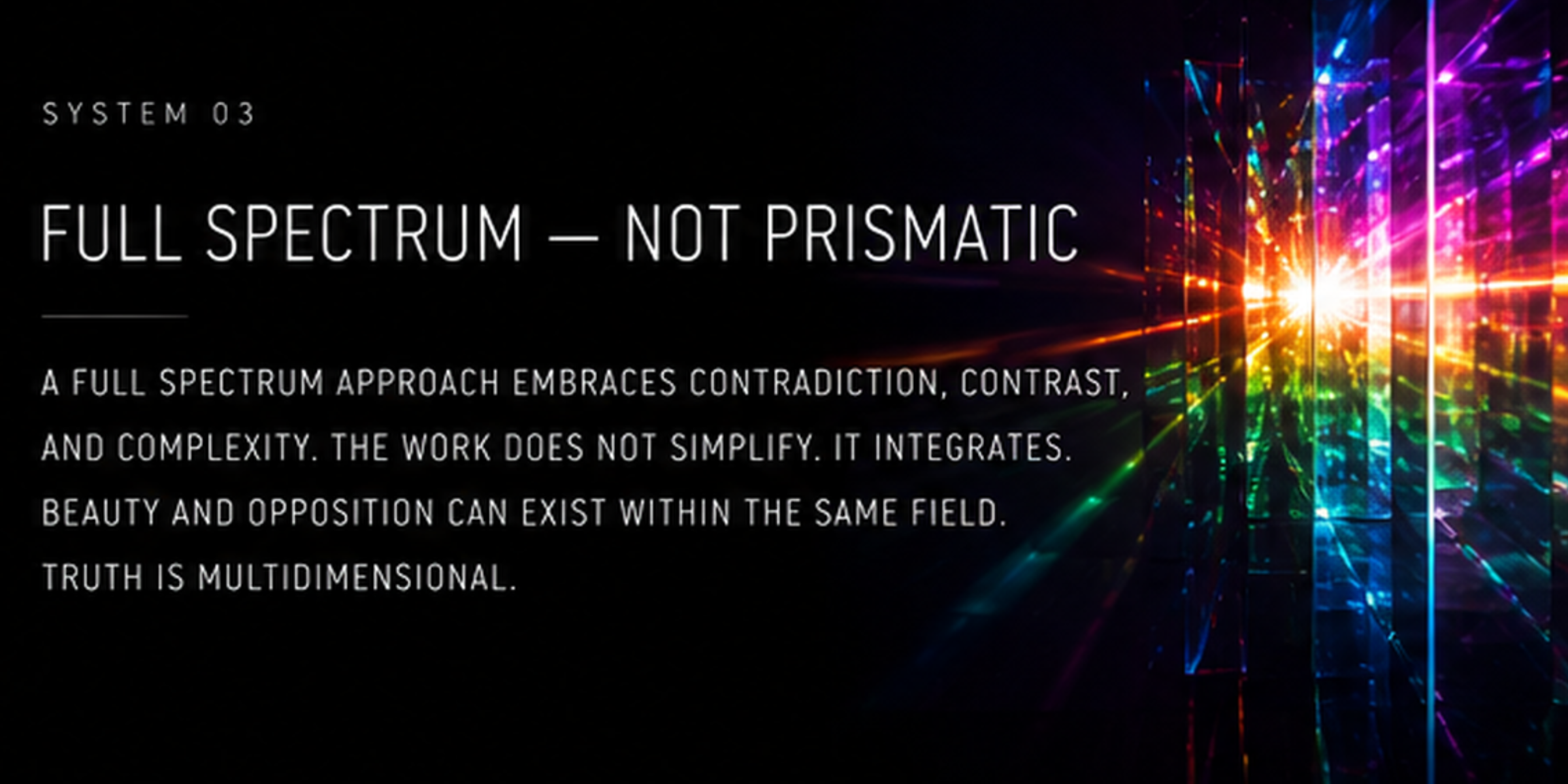
System 03: Full Spectrum — Not Prismatic A prism separates. I embody all of it. Red through violet. Every frequency simultaneously — the complete range held together, not split apart. That distinction is the whole practice.
In my work, color is not used as a decorative spectrum. It is used as a complete energetic system. I am not interested in separating experience into clean categories. I am interested in holding the full range at once: light and shadow, joy and grief, chaos and order, softness and intensity, visibility and mystery.
This is what I mean by full spectrum — not prismatic.
A prism divides light into separate colors. My practice does the opposite. It gathers the colors back into one field. It holds contradiction without needing to resolve it. It allows every frequency to exist simultaneously.
The work is not about choosing one color, one feeling, one identity, or one truth.
It is about holding the entire range.
A Prism Separates

A prism is often used as a symbol of beauty, color, and light. But a prism also separates. It takes white light and divides it into bands. It makes the spectrum visible by splitting it apart.
That separation is useful in science, but my artistic practice is not only about separation. It is about integration.
I am not interested in reducing experience to one clean line. I am not interested in simplifying identity into one category. I am not interested in making color behave as decoration.
My work exists in the place where everything overlaps.
Color overlaps with sound.
Sound overlaps with memory.
Memory overlaps with material.
Material overlaps with light.
Light overlaps with the body.
The body overlaps with space.
This is where the full spectrum lives.
I Embody All of It
To embody the full spectrum means to accept complexity as a material.
It means red is not separate from violet. Intensity is not separate from softness. Joy is not separate from grief. Beauty is not separate from rupture. The sacred is not separate from the strange.
Everything is part of the field.
This is deeply connected to how I understand myself as an artist. My practice does not come from a single discipline. It moves through installation, sculpture, light, mirror, color, sound, digital space, performance, public art, and immersive environments.
I do not separate these forms because my experience of the world is not separated.
The work holds multiple frequencies at once because I do.
Red Through Violet
The visible spectrum becomes a language for totality.
Red carries force, vitality, urgency, heat, and embodiment.
Orange carries motion, appetite, creativity, and transition.
Yellow carries radiance, clarity, electricity, and attention.
Green carries growth, balance, recovery, and natural vibration.
Blue carries depth, atmosphere, distance, and emotional expansion.
Indigo carries intuition, shadow, memory, and internal perception.
Violet carries transformation, mystery, spirit, and the edge of the visible.
But these colors are not isolated in my work. They move through one another. They collide, reflect, distort, intensify, and reorganize.
This creates a field where the viewer does not experience one emotion at a time. They experience a layered atmosphere. They feel the full chromatic register of the space.
Every Frequency Simultaneously
The full spectrum is not calm because it is complete. It is alive because it contains tension.
When every frequency is present, the work becomes dynamic. There is harmony, but there is also interference. There is beauty, but there is also pressure. There is clarity, but there is also distortion.
That complexity is important.
I do not want to create spaces that flatten emotion. I want to create spaces that allow people to feel the fullness of perception. The installations become environments where multiple truths can exist at the same time.
This is especially important in a world that often asks people, artists, and identities to become easier to understand.
My work resists that reduction.
It says: complexity is not confusion.
Complexity is truth.
Held Together, Not Split Apart
The distinction between prismatic and full spectrum is the distinction between separation and embodiment.
A prismatic approach isolates the parts.
A full spectrum approach holds them together.
This is why reflection is central to my practice. Mirror does not only show one thing. It multiplies. It allows the viewer to see fragments, angles, repetitions, distortions, and hidden perspectives. It refuses a single fixed image.
Glass behaves similarly. It catches light, bends it, reflects it, breaks it open, and sends it back into the room transformed.
These materials allow the work to hold more than one reality at once.
They make the full spectrum visible.
Beauty and Opposition Can Coexist
I believe beauty becomes more powerful when it is allowed to hold opposition.
Softness can exist with sharpness.
Light can exist with darkness.
Joy can exist with discomfort.
Order can exist with chaos.
Decoration can become architecture.
Spectacle can carry intelligence.
Color can carry emotional weight.
This coexistence is central to my installations.
The work may feel radiant, but it is not empty. It may feel playful, but it is not superficial. It may feel immersive, but it is not only visual. It is carrying pressure, memory, frequency, and contradiction.
The full spectrum allows the work to be beautiful and complicated at the same time.
Integration Over Simplification

System 03 is a refusal to simplify.
It is an insistence that the complete range has value. The work does not need to choose between science and emotion, physical and digital, personal and public, sacred and experimental, handmade and technological.
It can hold all of it.
This is the logic behind my practice. I build systems where different forces can speak to each other instead of canceling each other out.
Light becomes material.
Color becomes sound.
Sound becomes form.
Form becomes feeling.
Memory becomes reflection.
Technology becomes atmosphere.
The viewer becomes part of the circuit.
Nothing is isolated. Everything is connected.
Full Spectrum as Identity

Full spectrum is not only a visual strategy. It is an identity system.
It describes the way I move through art, culture, technology, community, visibility, and survival. It describes the way my work holds multiple histories, materials, and sensory languages at once.
As a first-generation Cuban-American artist from Miami, my practice is shaped by overlapping worlds: heritage, migration, sound, color, spirituality, nightlife, public space, digital culture, and experimental art.
The full spectrum allows me to hold those worlds together.
It does not ask me to split myself into parts.
It allows me to build from the whole.
Truth Is Multidimensional
A single angle can never hold the full truth.
This is why my work often uses mirrored surfaces, immersive environments, layered color, and spatial movement. The viewer has to move to understand the piece. Their perception changes depending on where they stand.
There is no one complete viewpoint.
That is intentional.
Truth is not flat. It is dimensional. It changes with position, light, context, memory, and time. My installations make that visible by creating spaces where perception is constantly shifting.
The full spectrum is not one answer.
It is the whole field of possible perception.
System 03 Statement
Full Spectrum — Not Prismatic is the third operating principle within my practice. A prism separates. I embody all of it: red through violet, every frequency simultaneously, the complete range held together, not split apart.
Through this system, I build immersive environments that hold contradiction, complexity, beauty, emotion, and multidimensional truth in the same field.
My work does not divide the spectrum.
It gathers it.
